🐢 This article contains affiliate links. We may earn a small commission if you purchase through them, at no extra cost to you. See the
full disclosure.
TL;DR: Coenzyme Q10 is one of the better-researched supplements in the longevity space, but its benefits are specific rather than transformative. The strongest human evidence is for chronic heart failure and statin-associated muscle symptoms. For healthy ageing, it is a reasonable mitochondrial-support option, especially after age 40 or for people taking statins. If you want a high-dose, low-cost UK option, a 500mg ubiquinone capsule from Amazon UK costs around £13.49 for a four-month supply.
🐢 Tortoise Wisdom
"CoQ10 won't make you live forever, but it may help the engine you already have run a little cleaner."
1. What Is CoQ10?
Coenzyme Q10 (CoQ10, also called ubiquinone) is a fat-soluble compound that sits in the mitochondrial membrane and shuttles electrons during ATP production. It also acts as an antioxidant in cell membranes and lipoproteins. The body makes CoQ10 from the same biochemical pathway used to make cholesterol — which is why statins, which block HMG-CoA reductase, also lower CoQ10 synthesis.
There are two main supplemental forms:
- Ubiquinone: the oxidised form; cheaper, stable, and converted to ubiquinol after absorption.
- Ubiquinol: the reduced, antioxidant form; better bioavailability in head-to-head studies but more expensive.
Both raise plasma and tissue CoQ10 levels. Ubiquinone is usually the better value choice unless you specifically need faster repletion.
2. Heart Failure Evidence
The most cited human trial is the Q-SYMBIO study, published in JACC: Heart Failure in 2014. In this multicentre double-blind trial, 420 patients with chronic heart failure received either CoQ10 300mg/day or placebo for two years. The CoQ10 group had a significant reduction in major adverse cardiovascular events and cardiovascular death.
A Cochrane review (2022) pooled smaller trials and found low-certainty evidence that CoQ10 may improve ejection fraction and reduce all-cause mortality. The UK-funded NIHR Health Technology Assessment review reached a similar conclusion: possible benefit, but not definitive enough for routine NHS recommendation.
Clinical takeaway: CoQ10 is not a replacement for prescribed heart-failure therapy, but it is one of the few supplements with trial evidence suggesting adjunctive benefit in this population.
3. Statin-Associated Muscle Symptoms
Muscle pain and weakness are common reasons people stop statins. Because statins lower CoQ10, supplementation is a biologically plausible remedy. Systematic reviews published in 2024 and 2025 suggest CoQ10 can modestly improve statin-related muscle symptoms in some patients, although results are mixed and not all trials show benefit.
⚠️ Important: Do not stop prescribed statins without speaking to your doctor. CoQ10 is an adjunct, not a substitute for cholesterol-lowering treatment.
4. Mitochondrial Energy and Healthy Ageing
CoQ10 is often marketed for fatigue, exercise recovery and healthy ageing. Human trial results in these areas are weaker and more inconsistent than for heart failure. Some small studies show improved endothelial function, reduced oxidative stress markers, and better exercise tolerance in older adults, but the effects are modest and not universal.
The honest framing is that CoQ10 supports a pathway (mitochondrial electron transport) that declines with age and statin use. Whether that translates into noticeably more energy depends on the individual.
5. Dosing and Form
| Use context |
Typical daily dose in trials |
Notes |
| Chronic heart failure |
100-300mg/day |
Q-SYMBIO used 300mg/day; use only as adjunct to standard care. |
| Statin myopathy |
100-200mg/day |
May take 4-12 weeks to notice improvement. |
| General healthy ageing |
100-200mg/day |
Take with a fat-containing meal. |
| High-dose single capsule |
500mg/day |
Convenient, but above most trial doses; unnecessary for many users. |
CoQ10 is fat-soluble, so absorption improves when taken with food. Dosing once daily is acceptable because CoQ10 has a relatively long half-life.
6. Product Reviews
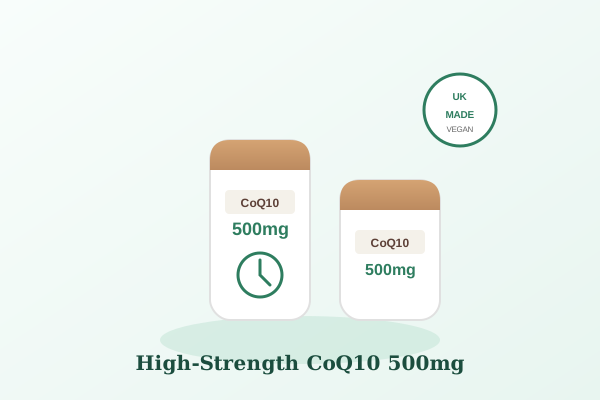
CoQ10 Supplement High Strength 500mg
120 vegan capsules (4-month supply) | Naturally fermented ubiquinone | Made in the UK | Amazon UK
★★★★★ 4.6/5 from Amazon UK reviews
Read full review →
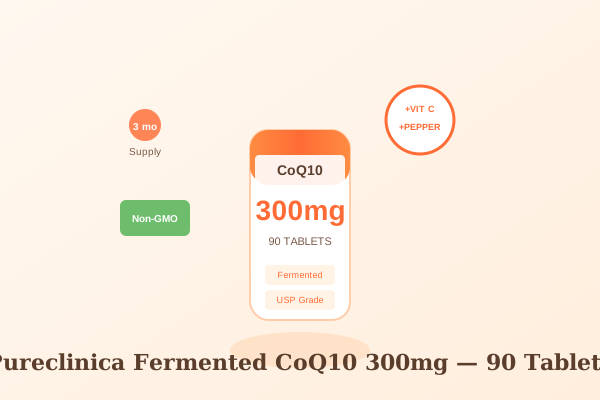
Pureclinica Fermented CoQ10 300mg
90 tablets (3-month supply) | Non-GMO USP grade | +vitamin C +black pepper extract | Amazon UK
★★★★★ 4.7/5 from Amazon UK reviews
Read full review →
The 500mg product offers one of the lowest per-milligram prices for high-dose CoQ10 in the UK. The 300mg Pureclinica option adds vitamin C and black pepper extract and is a better fit if you want a mid-range dose with absorption helpers.
Why the 500mg stands out:
- High dose in a single capsule.
- Low cost per day for a 500mg product.
- Vegan-friendly and letterbox-friendly packaging.
- UK manufacturing and Amazon Prime delivery.
Why the 300mg Pureclinica stands out:
- Matches the 300mg/day dose used in the Q-SYMBIO heart-failure trial.
- Added vitamin C and piperine (black pepper extract).
- Non-GMO and USP-grade fermented CoQ10.
- Three-month supply in one purchase.
Caveats:
- 500mg is above the dose used in most clinical trials; many users will not need this much.
- 300mg still requires medical review if you take warfarin, blood-pressure or diabetes medication.
- Ubiquinone is less bioavailable than ubiquinol, though still effective at raising CoQ10 levels.
View 500mg on Amazon UK →
View 300mg on Amazon UK →
7. Safety and Interactions
CoQ10 is generally well tolerated. Common side effects are mild: stomach upset, nausea, headache, insomnia. More importantly, it can interact with several medication classes:
- Warfarin and anticoagulants: CoQ10 is structurally similar to vitamin K and may reduce warfarin effect in some patients.
- Blood-pressure drugs: May have a small additive blood-pressure-lowering effect.
- Diabetes medications: May lower blood glucose slightly.
- Chemotherapy and immunosuppressants: Discuss with your oncology team; antioxidant supplements are not universally recommended during treatment.
⚠️ Not Medical Advice: If you have heart failure, take statins, or use prescription medicines, talk to a clinician before adding CoQ10.
8. Key Studies
Q-SYMBIO — Mortensen et al., 2014
CoQ10 300mg/day reduced cardiovascular death and hospitalisation in chronic heart failure over two years.
View DOI
Cochrane Review — CoQ10 for Heart Failure, 2022
Pooled analysis found low-certainty evidence for improved ejection fraction and reduced mortality.
View PubMed
NIHR HTA Systematic Review, 2022
UK-funded review assessed cost-effectiveness of CoQ10 in chronic heart failure with reduced ejection fraction.
View NIHR
Statin Myopathy Meta-Analysis, 2025
Systematic review and meta-analysis suggesting CoQ10 improves myopathy in statin-treated patients.
View DOI
9. FAQ
What is CoQ10 good for?
CoQ10 supports mitochondrial ATP production and acts as a lipid antioxidant. Human evidence is strongest for chronic heart failure and statin-associated muscle symptoms, not for lifespan extension.
Is ubiquinone or ubiquinol better?
Ubiquinol has higher measured bioavailability in some studies, but ubiquinone is converted to ubiquinol in the body and both raise total CoQ10 levels. Ubiquinone products are usually cheaper per milligram.
How much CoQ10 should I take?
Heart-failure trials have used 100-300mg/day; statin-myopathy trials often use 100-200mg/day. Healthy adults sometimes take 100-200mg/day. Always speak to a clinician if you take prescription medicines.
Can CoQ10 extend lifespan?
No human trial has shown that CoQ10 extends lifespan. It is best viewed as a targeted supplement for mitochondrial energy, heart-failure adjuncts, or statin-related muscle symptoms.
10. Affiliate Disclosure
This article contains affiliate links, including a link to the CoQ10 500mg supplement on Amazon UK. LongevityTortoise may earn a small commission if you purchase through these links, at no extra cost to you. This does not influence our editorial judgements.