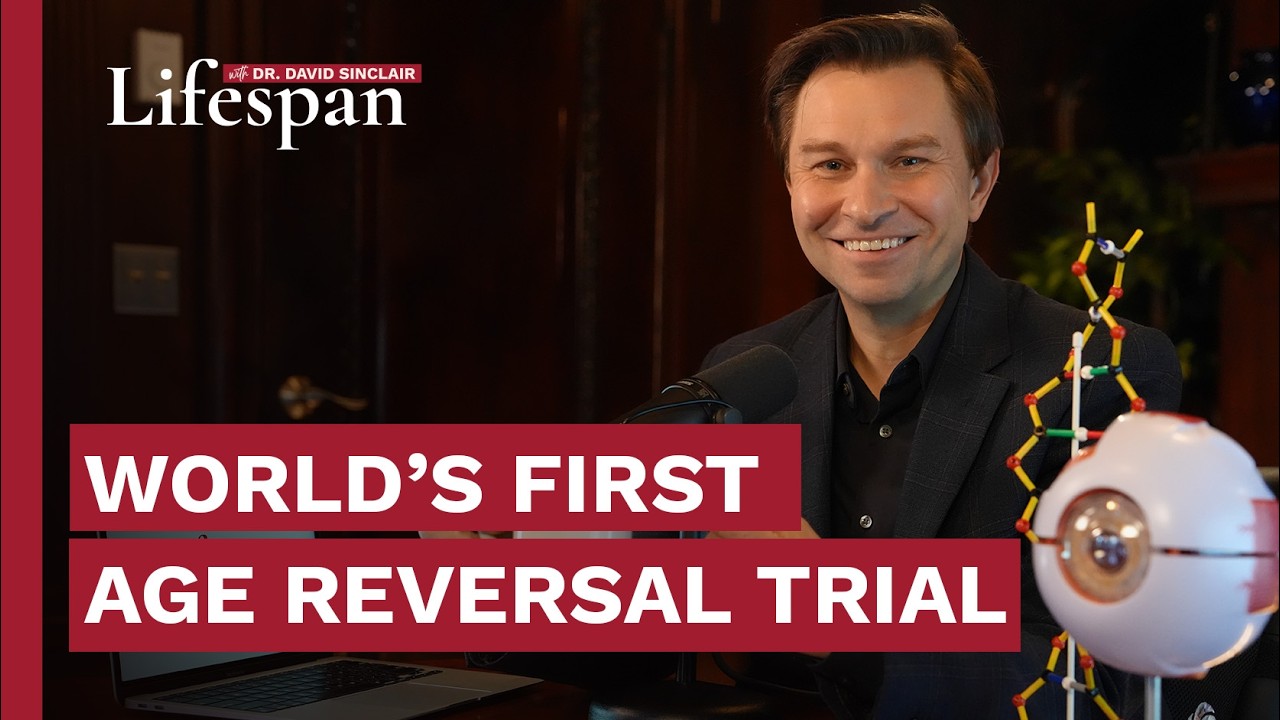
David Sinclair's Lifespan episode on the first human age-reversal trial using partial reprogramming. Watch below or on YouTube.
Disclosure: This article discusses experimental gene therapy, not a dietary supplement. ER-100 and similar reprogramming approaches are early-stage, invasive and not available for personal use. Nothing here is a product recommendation. Always consult a qualified healthcare professional for medical advice.
What are the Yamanaka factors?
In 2006, Shinya Yamanaka and Kazutoshi Takahashi showed that just four proteins could rewind adult mouse cells to an embryonic-like, pluripotent state. The proteins — Oct3/4, Sox2, Klf4 and c-Myc — are transcription factors that bind DNA and reshape which genes are switched on or off. Together they are known as OSKM, the Yamanaka factors, or the "four-protein complex" for cellular reprogramming. The discovery earned Yamanaka a share of the 2012 Nobel Prize in Physiology or Medicine and opened a new field: direct cellular rejuvenation without cloning.
Pluripotent cells can become almost any cell type in the body. In a dish, that is useful for making stem cells or disease models. In a living animal, however, full reprogramming is dangerous. It can erase cell identity, cause organs to fail and produce tumours, especially because c-Myc is a well-known oncogene. The goal of ageing research is therefore not to turn a skin or eye cell back into an embryo, but to nudge it part of the way — just enough to restore youthful function.
Partial reprogramming: turning back the clock without erasing identity
The idea of partial (or transient) reprogramming is to switch OSKM on briefly, let the cell shed some of its age-associated epigenetic noise, and then switch the factors off again before the cell loses its specialised identity. Think of it as restarting a computer to clear errors without wiping the hard drive.
The theoretical basis was laid by the information theory of ageing, developed by David Sinclair and colleagues at Harvard Medical School. In this view, ageing is driven in part by the loss of epigenetic information — the molecular marks that tell a cell which genes to express. Environmental insults, DNA damage and replication stress gradually scramble these marks, pushing cells toward dysfunction. Yamanaka factors can, in principle, restore the original epigenetic landscape because the youthful pattern is still encoded in the genome.
Early animal evidence: from sick mice to longer-lived mice
The first convincing in-vivo demonstration came in 2016. A team led by Juan Carlos Izpisúa Belmonte at the Salk Institute used an inducible OSKM system in a mouse model of premature ageing caused by a mutated lamin-A gene. Periodic, short pulses of the reprogramming factors improved tissue function, extended lifespan and did not produce tumours. The paper, published in Cell, showed that partial reprogramming could ameliorate age-associated hallmarks in vivo.
More recent work has pushed into naturally aged mice. A 2024 study by Cano-Macip et al. in Cellular Reprogramming used a gene-therapy vector to deliver OSKM in aged animals and reported lifespan extension plus reversal of several age-related molecular changes. As with all mouse ageing research, translation to humans is uncertain, but the results support the broader hypothesis that the epigenome can be partially reset in a living mammal.
| Study | Model | Key finding | Caveat |
|---|---|---|---|
| Takahashi & Yamanaka, 2006 | Mouse fibroblasts | Four factors generate induced pluripotent stem cells | In vitro; full reprogramming, not rejuvenation |
| Ocampo et al., 2016 | Progeroid mice | Cyclic OSKM ameliorates age-associated hallmarks and extends lifespan | Progeria model; not normal ageing |
| Cano-Macip et al., 2024 | Aged wild-type mice | Gene-therapy-mediated partial reprogramming extends lifespan and reverses age markers | Mouse only; delivery, dose and safety unknown in humans |
From mice to humans: ER-100 and the first patient dosed
By the mid-2020s, several biotech companies were trying to move partial reprogramming into the clinic. The most advanced is Life Biosciences, co-founded by Harvard longevity researchers including David Sinclair. Its lead candidate, ER-100, is an adeno-associated virus (AAV) gene therapy designed to deliver reprogramming factors to retinal ganglion cells.
In 2026, Life Biosciences announced that the first patient had been dosed in a Phase 1 trial of ER-100 for optic neuropathies, including glaucoma. The trial is listed on ClinicalTrials.gov as NCT07290244. The choice of the eye is deliberate: it is a small, enclosed tissue, visual function can be measured precisely, and optic-nerve damage is a major unmet medical need. Success would not prove whole-body rejuvenation, but it would be the first evidence that epigenetic reprogramming can be safely administered to humans.
MIT Technology Review reported in January 2026 that the first human test of a rejuvenation method was expected to begin shortly, framing the milestone as a watershed moment for the field. As with any Phase 1 study, the primary goal is safety and tolerability; efficacy signals, if they appear, will take years and larger trials to confirm.
Risks and open questions
Partial reprogramming is one of the most exciting but also one of the riskiest ideas in longevity medicine. Major unresolved issues include:
- Oncogenicity: c-Myc is a powerful growth promoter. Removing or replacing it is an active area of research.
- Cell identity: Even partial activation could disrupt specialised cells in the brain, heart or retina.
- Delivery: AAV vectors are useful for local tissues but may not reach every organ. Systemic rejuvenation is much harder.
- Dosing and timing: The ideal pulse length, interval and age to start are unknown.
- Long-term safety: Epigenetic changes can be stable; off-target effects may take years to surface.
Newer peptide and protein-based alternatives
Because gene therapy is invasive and c-Myc is hazardous, researchers are exploring safer ways to trigger reprogramming. Several approaches are emerging:
- c-Myc-free factor combinations: Replacing c-Myc with safer factors such as Nanog or Lin28 may reduce cancer risk while still rejuvenating cells.
- Chemically inducible systems: Small-molecule switches allow reprogramming to be turned on and off with pills rather than permanent genetic modification.
- Peptide-based delivery: Cell-penetrating peptides or protein transduction domains can ferry reprogramming proteins directly into cells, avoiding DNA-based vectors entirely.
- Partial reprogramming cocktails: Companies are testing shorter factor sets or modified versions that only partially activate pluripotency pathways.
These alternatives are mostly preclinical, but they point toward a future in which epigenetic rejuvenation might one day be delivered without gene therapy.
Watch: inside the world's first age-reversal trial
For a deeper explanation of whether ageing itself can be reversed, Sinclair's earlier lecture is also worth watching:
FAQ
What are the Yamanaka factors?
The Yamanaka factors are four transcription proteins — Oct3/4, Sox2, Klf4 and c-Myc, often abbreviated OSKM — that can reset a differentiated adult cell to a pluripotent stem-cell-like state.
What is partial reprogramming?
Partial reprogramming is a brief, controlled activation of Yamanaka factors that rejuvenates aged cells without erasing their identity. It aims to restore youthful epigenetic patterns while avoiding tumours or loss of cell function.
Is ER-100 available as a supplement?
No. ER-100 is an experimental gene therapy delivered by injection into the eye. It is in early-phase clinical trials and is not a dietary supplement or approved treatment.
References
- Takahashi K, Yamanaka S. Induction of pluripotent stem cells from mouse embryonic and adult fibroblast cultures by defined factors. Cell. 2006;126:663-676. doi:10.1016/j.cell.2006.07.024
- Ocampo A, Reddy P, Martinez-Redondo P, et al. In Vivo Amelioration of Age-Associated Hallmarks by Partial Reprogramming. Cell. 2016;167:1719-1733. doi:10.1016/j.cell.2016.11.052
- Cano-Macip C, Hasan R, Dayananda P, et al. Gene Therapy-Mediated Partial Reprogramming Extends Lifespan and Reverses Age-Related Changes in Aged Mice. Cellular Reprogramming. 2024;26:12-25. PMC10909732
- Life Biosciences. "Life Biosciences Announces First Patient Dosed in Phase 1 Trial of ER‑100 for Optic Neuropathies." 2026. Company announcement
- ClinicalTrials.gov. ER-100 in Optic Neuropathies. NCT07290244. Trial record
- MIT Technology Review. "The first human test of a rejuvenation method will begin 'shortly'." 27 Jan 2026. Read article
Published 4 September 2026. This article is for informational purposes only and is not medical advice. It discusses experimental gene-therapy research. Consult a qualified healthcare professional for any health concern. LongevityTortoise is an independent research review site.